The sun was still shining. It was warm, but the first dark clouds were already shifting over the Western town. On this early afternoon, we walked along Main Street, up to the show arena where the indigenous dancers were just being introduced.
At first, we looked for a spot outside the hall and sat on the wide steps, which reminded me a little of an ancient assembly place. From up here, we had a good vantage point to watch the event.The dancer from the Navajo Nation stepped onto the wooden dance floor and laid out a few hoops. Music from a culture and language foreign to me echoed from the speakers. In his regalia, he began to dance, and the round plastic rings seamlessly blended with his performance. Time and again, he created new symbols with them without interrupting his dance in any way. As if weaving a story, they seemed to unite in the Hoop Dance.Then, I felt something cold on my hand. My gaze drifted up to the sky as the next raindrop hit my face. I took my granddaughter by the hand; we ran to the entrance of the arena and just barely escaped the downpour that came rattling down on the Western town.

More dancers performed here, giving us a brief glimpse into the upcoming PowWow in the early evening. After the performances, we tried to pass the hours until then. Heavy rain showers kept pouring down, dampening my mood a bit. Finally, the time had come. In the early evening, we returned to the show arena where the PowWow was about to take place.
Something kept me from entering the event hall, though, so we stood in the sheltered outdoor area. From here, we had a good vantage point to follow the event.I saw a man in traditional clothing step onto the dance floor. He held a bowl in his hand and dispersed the smoke with a feather fan. The gray-white plumes accompanied him as he walked along the wooden floor, smudging the area. The smoke quickly spread like a fine mist throughout the hall, seeming to touch everything gently. Before it dissolved and merged with the emptiness around us, the scent of sweetgrass reached my nose as well. Suddenly, a familiar feeling arose within me, and I paused to listen to my inner self. For a brief moment, I was connected to a childhood memory. I saw the small wooden pipe before me, which we children had stuffed with dried grass. We lit the hay, the white smoke rose up, and it resembled the aroma of the sweetgrass now lingering over the PowWow. For a moment, I was incredibly close to a time that had already been forgotten.
The voice of the German announcer drew my attention back to the action. I saw the many different people, some of whom had adapted to the indigenous cultural event, even in their clothing. Some of them began to line up, forming a row led by the young Sioux man. He held a flag decorated with eagle feathers in his hands – the Eagle Staff. With mindful and proud dance steps, he stepped onto the wooden floor. Moving to the rhythm of the drums, the others followed him until they had formed a large circle formation. Then, the flag bearers stepped out of the circle and moved to the center. In a ceremony, the individual flags were honored, handed over, and set up next to the judges' desk. Now the PowWow was officially open, and the audience was invited to join the guests from America for the "Intertribal Dance" – the collective dancing.
"Grandma, we have to dance, too!" my granddaughter urged, pulling gently on my hand. She caught me completely off guard. Unease spread through me, and I started searching for excuses. I felt a real barrier inside and tried to wiggle my way out like an eel. But when I looked into her eyes, which were glowing with excitement, I had already lost. Besides, I wanted to truly experience a PowWow – and I can only experience something if I become a part of the whole. So we headed into the hall, blended into the crowd, and found a spot at the edge of the action. When we arrived, the dance floor was just being cleared again to make room for the upcoming performances. The voice of the speaker echoed through the loudspeaker, guiding everyone through the event. The first dancer was announced, accompanied by a brief piece of information about the regalia and the meaning of the dance.
(The commentary in this video is in German, but the performance and music are universal.)
The dancer from the Navajo Nation stepped onto the wooden dance floor. It was the man we had already watched under the arena's awning earlier that morning. He was an experienced dancer, presumably around fifty years old, and laid out a few hoops. Music and singing that were familiar to him echoed once more from the speakers. In his regalia, he began to dance, and the round plastic rings merged with his performance. Time and again, he created new symbols with them without interrupting his dance in any way. As if weaving a story, they seemed to unite in the Hoop Dance. Further impressive regalias and dances allowed me to share in a culture that is so foreign to us, yet seems familiar. Some performances were also danced by non-natives to give the audience an impression of the diversity of the various PowWow dances and clothing.
Between the performances, another "Intertribal" came up, and this time, we entered the dance floor as well. The small child's hand slid into mine; I felt the gentle pressure, as if it offered us both trust and security as we immersed ourselves in the crowd. For a few moments, we lingered on the wooden dance floor, looking around and observing everything like a snapshot that wants to capture every single detail. Then, my feet began to move as well, following the invitation of the foreign sounds. In the rhythm of the drum and the singing, we merged with the dancers.

A colorful, diverse group of people moved together to the drumbeats. In this moment, it didn't seem to matter where you came from, whether man or woman, with a disability, or what color your skin was. Right in the middle were the PowWow dancers from America, whose movements and uniqueness flowed through the people and united them in dance. They let us share in their culture, which seems familiar and yet is so far removed from what shapes and defines our daily lives.
All of a sudden, I noticed the pressure in my hand tightening. The Sioux dancer was dancing expressively right next to us. He towered over us by several head lengths and seemed completely connected to his movements. His regalia completed this impressive sight. Unvermittelt, he let out a loud shout, and we automatically jumped. The startled shock quickly turned into a smile, accompanied by a cool, enthusiastic "Wow, cool!" from my granddaughter. I was still completely captivated by this scene when the traditional Zuni/Omaha dancer appeared beside us. He, too, seemed entirely at one with his movements. His face was painted, and despite the loud music, we could hear the small bells adorning his clothing. Moving to the rhythm of the drums, he passed us by.
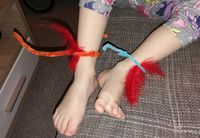
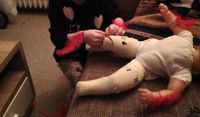
Suddenly, my granddaughter stopped and watched the dancer leave. She seemed to observe everything intently. Then, the little body moved again, making an effort to match her dance steps to those of the PowWow dancer.
Anyone who sees a Native American dance can feel this deep connection to their culture. These people don't just dance; they are the dance. They seem at one with every movement and with every piece of their regalia. Their music flows through their bodies; they merge, awaken, and preserve within it the soul of their people and their culture. At least, that is the impression it left on me..
All of these people had been drawn here on this evening. Everyone had come with their very own story, thoughts, and intuition. Everyone would leave this arena with their individual impressions, images, and emotions. Some will quickly return to their everyday routines, and the memories will fade. But some will also take this small glimpse into the culture of Native Americans with them like a new stone – painted with a colorful memory that enriches their own path in life.
The dance gathering has left a lasting memory on my granddaughter. In her childhood play, she processes this special experience and works through her impressions. When she started asking me many questions and I couldn't answer them, I realized how little I actually know about the cultures, history, and traditions of Native Americans